College Competitions in India 2026: The Complete A–Z Guide for Students
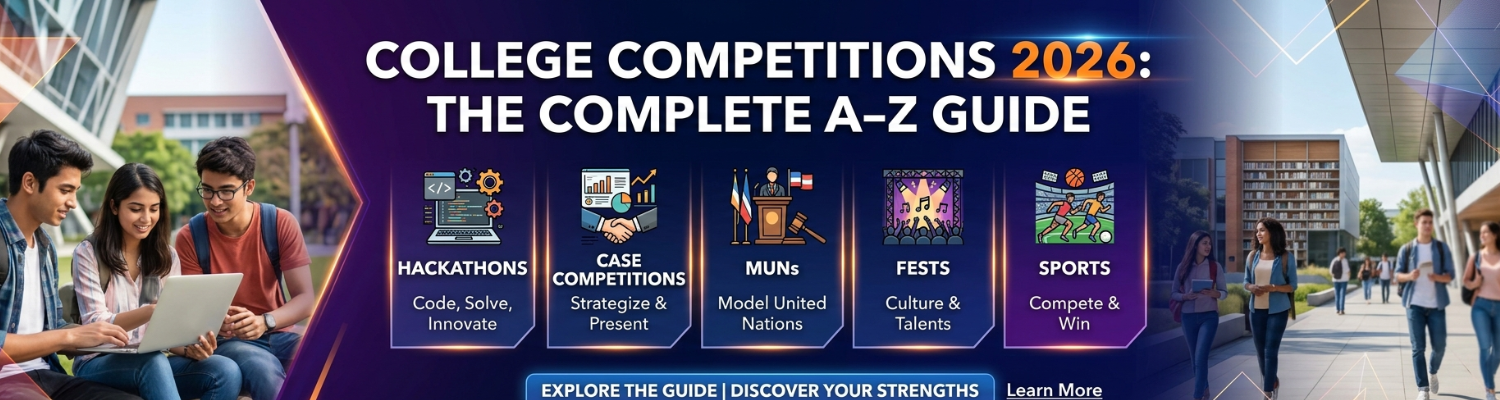
College competitions in India include hackathons, business case competitions, quiz contests, Model United Nations conferences, design challenges, coding contests, sports tournaments, and cultural fests. Most are open to students from any college, not just the host institution. The right competitions build skills, strengthen resumes, and open career opportunities that classroom performance alone cannot. This guide covers every major competition type, how to find them, how to register, and how to choose the right ones for your specific career goal.
If you've spent a semester watching your peers rack up competition wins, certificates, and internship calls while you stayed on campus and studied, this guide is written specifically for you.
The problem isn't that you lack opportunities. India has one of the most active college competition ecosystems in the world. The problem is that nobody tells first and second-year students how this ecosystem actually works, which competitions exist, which ones are worth your time, how to find them before the deadline, and how to choose based on where you want to go in your career.
This guide fixes that. By the end, you'll have a clear map of every major competition category, a framework for choosing the right ones, and a step-by-step process for registration, whether you're an engineering student eyeing hackathons or an MBA aspirant building your case competition record.
What Are College Competitions in India?
College competitions in India are structured academic, technical, cultural, or athletic contests that college students can enter either individually or as a team to demonstrate skills, win prizes, and build credentials outside the classroom.
There are two types of college competitions you need to understand:
Intra-college competitions are organized within your own institution, open only to students of that college. These are useful for campus visibility, but they don't travel on your resume the way external wins do.
Inter-college competitions are organized by one institution but open to students from any college across the city, state, or country. These are the ones that matter for your career. A win at an inter-college case competition hosted by IIM Bangalore or IIT Bombay carries significantly more weight than the same win at your own institution's internal event.
The distinction matters because most students default to intra-college events out of convenience and miss the larger, more competitive, more career-defining inter-college circuit entirely.
The Campus Competition Matrix: All Major Types in India
This is the first time a complete taxonomy of Indian college competition types has been mapped to their format, effort, and career value. Use this as your decision framework.
1. Technical Competitions: Hackathons, Coding Contests, and Robotics
Hackathons are timed problem-solving events typically 24 to 48 hours long where teams build a working prototype or solution to a real-world problem. They're the most widely known competition format in India right now, and for good reason: they combine technical skills, product thinking, and team dynamics in a way that employers directly value. If you're new to this format, read the complete guide on what is a hackathon and how it works for college students before registering for your first one.
Major annual hackathons in India include Smart India Hackathon (government-backed, national scale), HackCBS at Delhi University, and dozens of college-level hackathons run by IITs, NITs, and BITS campuses.
Coding contests are algorithmic problem-solving competitions that platforms like CodeChef host online, while many colleges hold offline coding contests as part of their technical fests. These are primarily individual events and reward pure programming speed and logic.
Robotics and hardware competitions involve building physical systems that complete tasks, from line-following robots to autonomous drones. These are common at engineering fests and IIT technical events like Techniche (IIT Guwahati) and Shaastra (IIT Madras).
Best for: Computer science, electronics, and mechanical engineering students. Also increasingly relevant for AI/ML and data science students.
Career signal: Software companies, deep-tech startups, and research organizations specifically look for hackathon participation and coding contest rankings. A top-10 finish in Smart India Hackathon or CodeChef's Starters series is meaningful on a resume.
2. Business Competitions: Case Studies, B-Plans, and Marketing Challenges
Case study competitions are the most prestigious business competition format in India. Teams receive a real business problem, typically from a partner company, and have 24 to 48 hours to analyze it and present a structured recommendation. These are primarily hosted by MBA colleges (IIMs, XLRI, MDI, SPJIMR, ISB) and occasionally B-school fests like Confluence. If you've never entered one before, start with our detailed walkthrough on how to solve a case study competition from first principles. It covers framework, structure, and presentation in one guide.
Business plan competitions ask students to develop a full startup idea, market research, financial model, go-to-market strategy, and pitch and defend it in front of judges who are often investors or industry veterans.
Marketing and brand management challenges are run by FMCG companies (HUL, ITC, P&G, PepsiCo) and ask students to solve brand strategy problems. These are high-visibility competitions with direct recruitment pipelines many participants receive PPO (pre-placement offer) consideration.
Finance and quant challenges involve financial modeling, stock pitching, or quantitative analysis problems. CFA Institute and several IIM finance clubs run these regularly.
Best for: MBA aspirants, BBA students, BCom students, and economics/commerce undergrads. Engineering students with a business interest also compete effectively.
Career signal: B-school case competition wins are among the strongest non-CGPA credentials you can carry into a B-school application or first job interview. They demonstrate real-world analytical thinking.
3. Cultural and Arts Competitions: Fests, Design, Film, and Music
India's college cultural fest circuit is one of the largest student event ecosystems in the world. Festivals like Mood Indigo (IIT Bombay), Rendezvous (IIT Delhi), Saarang (IIT Madras), and Antaragni (IIT Kanpur) attract participants from hundreds of colleges nationally.
Cultural competitions span:
- Performing arts: Dance (solo, group, western, classical), music (solo, band, fusion), drama, and spoken word
- Visual arts and design: Photography, digital art, graphic design, and illustration contests
- Film and media: Short film contests, documentary competitions, and journalism challenges
- Fashion and lifestyle: Ramp walk, fusion wear, and fashion design competitions
These competitions are often undervalued by students who are focused purely on career-building. That's a mistake. Cultural competition wins demonstrate creativity, communication, stage presence, and the ability to collaborate, qualities that matter in every career.
Best for: All students, regardless of stream. Cultural competitions are the most accessible entry point to inter-college competition for students who aren't yet ready for technical or business formats.
4. Debate, MUNs, and Model Parliament
Model United Nations (MUN) conferences simulate UN committee sessions. Delegates represent assigned countries and debate real global policy issues, such as climate change and refugee rights, following formal parliamentary procedure. MUNs are hosted by nearly every major college in India, from small city conferences to national-scale events like DAIMUN.
Parliamentary debate competitions use the British Parliamentary or Asian Parliamentary format to debate motions on current affairs, policy, philosophy, and ethics.
Moot court competitions are for law student teams to argue a fictional legal case before a panel of lawyers or judges. These are the law-student equivalent of case competitions.
Model G20, Model Parliament, and similar simulations have grown significantly since 2022 and offer a newer, less saturated competition circuit.
Best for: Students aspiring to civil services, law, policy, management consulting, and corporate communications. MUN participation is increasingly recognized by B-school admissions committees as evidence of communication and research skills.
Career signal: Regular MUN participation, especially Best Delegate awards, is a meaningful differentiator for law school applications, civil services preparation, and management program admissions.
5. Academic and Research Competitions
Quiz competitions range from informal college-level quizzes to serious national-level open quizzes. The Tata Crucible Campus Quiz is the most prestigious business quiz in India.
Research paper and essay competitions ask students to write on assigned topics and submit written work for blind peer evaluation. These are common in economics, social sciences, public policy, and engineering disciplines.
Olympiads and subject competitions
Science and innovation challenges like the National Innovation Challenge and INAE Youth Conclave reward original research and technical innovation from undergraduate students.
Best for: Students targeting academic careers, research programs, PhD applications, or professional fields that value domain depth (law, economics, sciences).
6. Sports: Inter-College Leagues and Tournaments
Inter-college sports competitions are the most underrepresented category in discussions about student development, yet they're one of the most consistent predictors of discipline, teamwork, and resilience.
Every university-affiliated college participates in inter-college sports leagues organized by the university (Delhi University League, etc.). Beyond these, colleges host their own open sports tournaments, such as football, cricket, basketball, badminton, chess, and esports, that are open to students from other institutions.
Esports competitions are growing fast.
Best for: All students. Sports competition participation signals physical discipline and team orientation. For roles in sports management, sports marketing, or fitness industries, competitive sports history is directly relevant.
Who Can Participate in Inter-College Competitions? (Myths Busted)
Myth 1: Only students from top colleges get in. False. Inter-college competitions are open to all enrolled college students regardless of institution tier. The registration form asks for your college name and enrollment number, not your NIRF rank. What matters is your submission, presentation, or performance.
Myth 2: You need your college's permission to register. For most competitions, no. Individual student registration is accepted directly. Some competitions require institutional endorsement for team events or for access to resources, but the vast majority allow direct student registration.
Myth 3: Only final-year students or MBA students compete. False. Most competitions explicitly welcome 1st and 2nd-year students. Many competitions have specific categories for freshers. Hackathons especially see strong first-year participation.
Myth 4: You need a team to enter. Many competitions have individual categories. Solo hackathon tracks, individual coding contests, solo debate, individual quiz, and individual research paper submissions are all common formats.
Myth 5: Online competitions don't count. Online inter-college competitions are fully recognized by employers and B-school admission committees, especially when hosted by reputed institutions. A win in IIM Bangalore's online case competition carries the same institutional weight as an offline one.
How to Find College Competitions in India: The Discovery Stack
Most students miss competitions not because they don't exist, but because the discovery process is fragmented. Here is every reliable channel, ranked by reliability:
1. Dedicated event platforms: Campus Cliq is a college event discovery platform that aggregates verified inter-college competitions, fests, conferences, and sports events across India. Students can search by competition category, city, and format to find opportunities beyond their own campus. Unlike general social media, platforms like Campus Cliq list competitions with accurate deadlines, eligibility criteria, and registration links, which means no wasted time chasing expired opportunities. If you're based in Delhi NCR, we also have a detailed breakdown of college competitions in Delhi NCR and how to access them as a starting point.
2. College social media pages, Instagram is where most college fest committees post first. Follow the Instagram pages of 10–15 major colleges in your city and in your field of interest. Set notifications. Competitions are typically announced 4–6 weeks before registration closes.
3. LinkedIn Search "inter-college competition" or "hackathon 2026" on LinkedIn. Student organizers and competition committees post announcements here, and your network's activity will surface competitions your connections are entering or organizing.
4. WhatsApp student groups. College-to-college networking groups, department WhatsApp groups, and city-level student communities share competition information faster than any formal channel. If you're not in these networks, ask seniors in your college to add you.
5. College notice boards and DSW office. Old-fashioned but reliable. Many inter-college competitions officially invite colleges through DSW (Dean of Student Welfare) channels. Checking the notice board or DSW email lists catches competitions that don't make it to social media.
6. Direct college website listings. Every major college that hosts a competitive fest maintains an events page with competition details and registration timelines. Bookmark 5–10 of these and check them at the start of each semester.
How to Evaluate a Competition Before Registering: The 5-Question Framework
Not every competition is worth your time. Before registering for anything, ask these five questions:
Question 1: Who is the organizing institution? A competition hosted by an IIT, IIM, BITS, or a reputed autonomous college carries significantly more resume weight than one hosted by an unknown organizer. Check whether the organizing college is NAAC-accredited and whether the competition has been running for multiple years; both are credibility signals.
Question 2: Does the competition format match what I want to develop? Entering a marketing challenge when you want to build technical skills wastes your preparation effort. Choose competitions whose format, case solving, coding, debate, and design aligns with the skill you are actively trying to build.
Question 3: What is the time investment vs. career return? A 48-hour hackathon requires two days. A business plan competition may require two weeks of preparation. A research paper submission may require a month. Map the effort against the credential value honestly.
Question 4: Is the competition verifiable? Can you find the organizer on social media? Is the competition listed on the college's official website? Has it run in previous years (previous editions usually appear on LinkedIn or Instagram)? If a competition cannot be verified independently, skip it.
Question 5: Does it have a real evaluation process? Competitions with named judges, established rubrics, and published previous winners are real. Competitions that promise large prize money but provide no information about judges or evaluation criteria are often pay-to-win or pay-to-participate schemes.
How to Choose Competitions Based on Your Career Goal
This is the section most guides skip. Here is the Campus Competition Matrix a direct mapping of competition types to career outcomes.
Engineering and Technology Students
If you are targeting software roles, product companies, or startups: prioritize hackathons, coding contests, and open-source contribution challenges. A hackathon win with a working GitHub repository is more valuable than a certificate from a quiz competition.
If you are targeting research or higher studies abroad, prioritize research paper competitions, science and innovation challenges, and project competitions. These demonstrate the depth of thinking that research program applications look for.
If you are exploring product management or consulting, mix hackathons with one or two case competition entries. The combination shows both technical and business thinking, a rare profile that top consulting firms and product companies recruit aggressively. For a detailed breakdown of how different competition formats map to specific career paths, read our guide on how to choose college competitions based on your career goal.
MBA and Management Students
If you are in an MBA program or preparing to apply, case competitions at IIM and other top B-schools are your highest-return investment. A shortlisting event is a meaningful credential in B-school applications and summer internship recruitment. Before you enter, go through the 10 case competition mistakes MBA teams make. These are the errors that eliminate strong teams in round one.
Marketing students should prioritize FMCG brand challenges, such as the Mahindra War Room, which have direct PPO pathways.
Finance students should target quant challenges, stock pitch competitions, and the CFA Institute Research Challenge.
BBA and Commerce Students
BBA students are in a strong position across most business competition formats. Case competitions, business plan challenges, and marketing battles all have categories open to undergrads. Use your first and second year to enter as many as possible early losses are learning reps that make you competitive by third year.
Entrepreneurship-focused competitions like E-Summit (IIT Bombay), E-Cell competitions, and national startup challenges are particularly well-matched for BBA students who want to build or join startups.
Law, Arts, and Social Science Students
Law students: moot court competitions are your primary circuit. Virtually every law school in India runs these, and wins at inter-college moot courts are directly recognized in legal career hiring and LLM application processes.
Social science, economics, and humanities students: research paper competitions, MUNs, essay competitions, and public policy challenges are your primary circuit. The Indian Model G20 and similar simulations offer newer competitive formats with growing institutional recognition.
Arts and design students: portfolio competitions, design challenges, film contests, and photography events are the most accessible. These often have the smallest participant pools in proportion to prize value.
How to Register for Inter-College Competitions: Step by Step
Step 1: Find the competition through a verified source, then go to the official registration page. The safest starting point is a dedicated college event platform. Browse inter-college competitions on Campus Cliq; every listing is verified with the organizing institution's official details, deadline, and direct registration link. This removes the risk of landing on outdated or fraudulent registration pages that circulate on social media. Once you find a competition on Campus Cliq, the registration link takes you directly to the organizer's official page. Never register through an unverifiable third-party link shared in a WhatsApp forward or random social media post.
Step 2: Read the eligibility criteria completely. Check: Which year of study? Which streams are eligible? Is it team or individual? Is a college registration required before individual registration? Missing an eligibility detail after investing preparation time is the most avoidable mistake in this process.
Step 3: Prepare your registration documents in advance. Most competitions require: student ID, college enrollment certificate, and a team constitution (for team events). Keep scanned PDFs of these ready so registration takes minutes, not hours.
Step 4: Register before the early deadline if one exists. Many competitions have an early-registration fee waiver or an early-access round. Registering in the first week of opening often gives you access to preparatory materials, previous year case studies, or practice rounds that late registrants miss.
Step 5: Confirm your registration via the confirmation email. Always verify that your registration email was received and that your team registration (if applicable) is complete and not just pending. Follow up with the organizing team if you don't receive a confirmation within 48 hours.
Step 6: Add the competition schedule to your calendar immediately. Submission deadlines, presentation dates, and elimination round schedules are non-negotiable. Missing a deadline because of a scheduling conflict is the single most common reason strong teams get eliminated before competing.
Common Mistakes Students Make With College Competitions
Registering without preparing. Registering for a case competition without understanding the case format, or entering a hackathon without knowing what problem statements they typically issue, is the fastest path to a demoralizing first experience. Two to three weeks of format-specific preparation before your first competition changes everything.
Choosing competitions based on prize money, not skill alignment. A ₹50,000 prize in a finance competition does nothing for your resume if you're a mechanical engineer who hasn't studied finance. Choose based on career relevance first, prestige second, prize money last.
Treating competition season as something that happens in the final year. The students who compete effectively in their final year started in their first year. The first two years are for building competition skills, learning formats, finding team members, and understanding how to work under pressure. The final year is for converting those skills into credentials.
Participating alone when the format rewards teams. Most case competitions and hackathons are designed for teams of 3–4. Entering as a solo participant or with a mismatched team is a structural disadvantage. Build your competition team the same way you would build a startup team: complementary skills, reliable work ethic, and communication fit.
Never reviewing what went wrong. Post-competition review is the single highest-leverage activity available to a student who wants to improve. After every competition win or loss, sit with your team and reconstruct exactly where your approach broke down. Students who do this consistently become significantly better competitors within 6 months.
Frequently Asked Questions About College Competitions in India
Can a student from any college participate in inter-college competitions? Yes. Inter-college competitions in India are open to students from any recognized college, regardless of institution tier, location, or affiliation. The organizing institution may verify your enrollment, but it does not filter based on college ranking. Students from tier-2 and tier-3 colleges regularly win competitions hosted by IITs and IIMs.
How early should I start looking for competitions? The most competitive inter-college competitions, IIM case competitions, IIT hackathons, and national MUNs typically open registration 4 to 6 weeks before the event date. For major annual events, the announcement often comes at the start of the academic semester. Checking platforms like Campus Cliq at the beginning of each semester covers most of the important registration windows.
Do I need my college's permission to participate in inter-college competitions? For most individual registrations, no. Some team events require an institutional letter of endorsement, but the majority of competitions allow direct student registration. Check the specific competition's eligibility section for institutional requirements.
Are online inter-college competitions recognized on resumes? Yes. Online competitions hosted by reputed institutions carry the same institutional credibility as offline ones. What matters is the organizing institution, the evaluation process, and the placement in the competition, not the mode of delivery.
What is the difference between a hackathon and a coding contest? A hackathon is a product-building event where teams build a working solution to a real problem within a time limit, typically 24 to 48 hours. A coding contest is an algorithmic problem-solving event where participants solve programming challenges in a competitive time frame. Hackathons reward product thinking, teamwork, and creativity; coding contests primarily reward algorithmic speed and precision.
How many competitions should I participate in per semester? Quality over quantity is the operative principle here. Two to three well-prepared competition entries per semester yield significantly better outcomes than seven to eight under-prepared ones. Focus on competitions that align with your career goal, prepare seriously for each, and review performance after each one.
What do employers actually look for in competition history? Employers look for three things: (1) the credibility of the organizing institution, (2) the relevance of the competition format to the role being applied for, and (3) the depth of involvement. A well-articulated explanation of what you did, what you learned, and what you would do differently is more valuable than a credential you can't speak to.
Are there competitions specifically for first-year students? Yes. Many competitions have explicit fresher categories or are designed to be accessible without prior domain knowledge. Hackathons are particularly first-year friendly; product thinking and creativity matter more than technical depth. MUNs are also excellent first-year entry points because they reward preparation and communication over accumulated domain expertise.
How do I find competitions if I'm from a smaller city or a tier-2 college? Online competitions have eliminated geography as a barrier to inter-college competition participation. Most hackathons, case competitions, MUNs, and research paper competitions have online rounds or are fully online. Platforms like Campus Cliq list competitions by format (online, offline, hybrid) so students from any city can filter to find competitions they can enter, regardless of location.
How Campus Cliq Fits Into This
Campus Cliq is a college event discovery platform that aggregates verified inter-college competitions, fests, conferences, clubs, and sports events across India. Students use Campus Cliq to find competitions beyond their own campus, filtered by category, city, stream, and competition format. Colleges and student event organizers list their competitions and fests on Campus Cliq to reach student participants from institutions across the country.
Unlike general social media or search results, Campus Cliq lists competitions with verified deadlines, eligibility requirements, and direct registration links. This means students don't waste time chasing competitions that have already closed or that they're ineligible for.
For students who are just starting to build their competition history, Campus Cliq discovery function solves the single biggest problem: finding opportunities that exist before the deadline passes.
Start Your Competition Journey
College competitions in India are not for a select group of students at elite institutions. They are open, accessible, and available to every enrolled student regardless of which college you attend, which year you're in, or what your CGPA says.
The students who build strong competition records by the time they graduate aren't necessarily the smartest in the room. They are the ones who started earlier, prepared more intentionally, and treated each competition win or loss as a data point in a longer learning process.
The best time to start was the first year. The second-best time is now.
Browse inter-college competitions across India on Campus Cliq, filter by domain, city, and format to find the right opportunity for your stream and your career goal. Explore all competitions on Campus Cliq.